Product updates
What has been built, dated and honest.
A plain record of progress. Every update says what exists and on what kind of data, so nothing here can be mistaken for a live service.
Restart baseline and first model run
The clinical build was re-baselined on synthetic data. A first model-in-the-loop run on synthetic development documents was recorded; the locked holdout was not used. Access, freshness and closure rules were moved into the clinical logic on a branch that is awaiting review and not yet part of the development build.
- The first model-in-the-loop run used 89 synthetic development documents (13 November 2026), through a development harness rather than the intended production provider. Its thresholds are provisional and no accuracy figure is claimed.
- In the development build, access, freshness and closure rules are still enforced by Reedley’s own screens; the branch that moves them into the clinical logic is awaiting review.
- On that branch, safeguarding-classified content is shown to a GP, pharmacist or nurse with a flag and an audited view by default; non-clinical roles need an explicit grant, and a practice can withhold it from clinicians only by recording a rationale. Not reviewed by a Clinical Safety Officer, safeguarding lead or information-governance lead.
Public website preview
A first preview of this website, including an interactive demonstration on synthetic data, a trust centre and an honest assurance register.
- Three synthetic demonstration scenarios: a discharge summary, a laboratory result and a specialist clinic letter.
- Trust centre pages for clinical safety, responsible AI, security, integration status and vulnerability disclosure.
- A public assurance register that states what exists, what does not yet, and what comes next.
Build block 4: freshness, access policy and request preparation
The fourth build block added freshness tracking that marks derived information stale, an access policy within the practice, and new prescribing and results workflows — all on synthetic data. These rules are enforced by Reedley’s own screens, not yet by a server.
- Derived information is marked stale when the record changes and Reedley’s screens refuse action on it until it is refreshed; decisions are snapshotted with what was known at the time.
- An intra-practice access policy, enforced by Reedley’s screens: each role sees what it needs, with every attempt recorded; at this date safeguarding information needed an explicit grant (the default changed on 14 November, on the branch awaiting review).
- Prescription request preparation for a prescriber’s review, which never labels a request “safe”. Its sorting rules await clinical sign-off.
- Results read once received in the record, linked to why they were requested and used to verify open work; follow-up loops with stalled steps visible.
- A 128-document synthetic corpus across 16 specialties for model evaluation. At this date the model-in-the-loop suite had not been run; its first run was on 13 November.
- Honest readiness count: none of the thirty tracked capabilities is launch-ready, and no clinician has used the build yet.
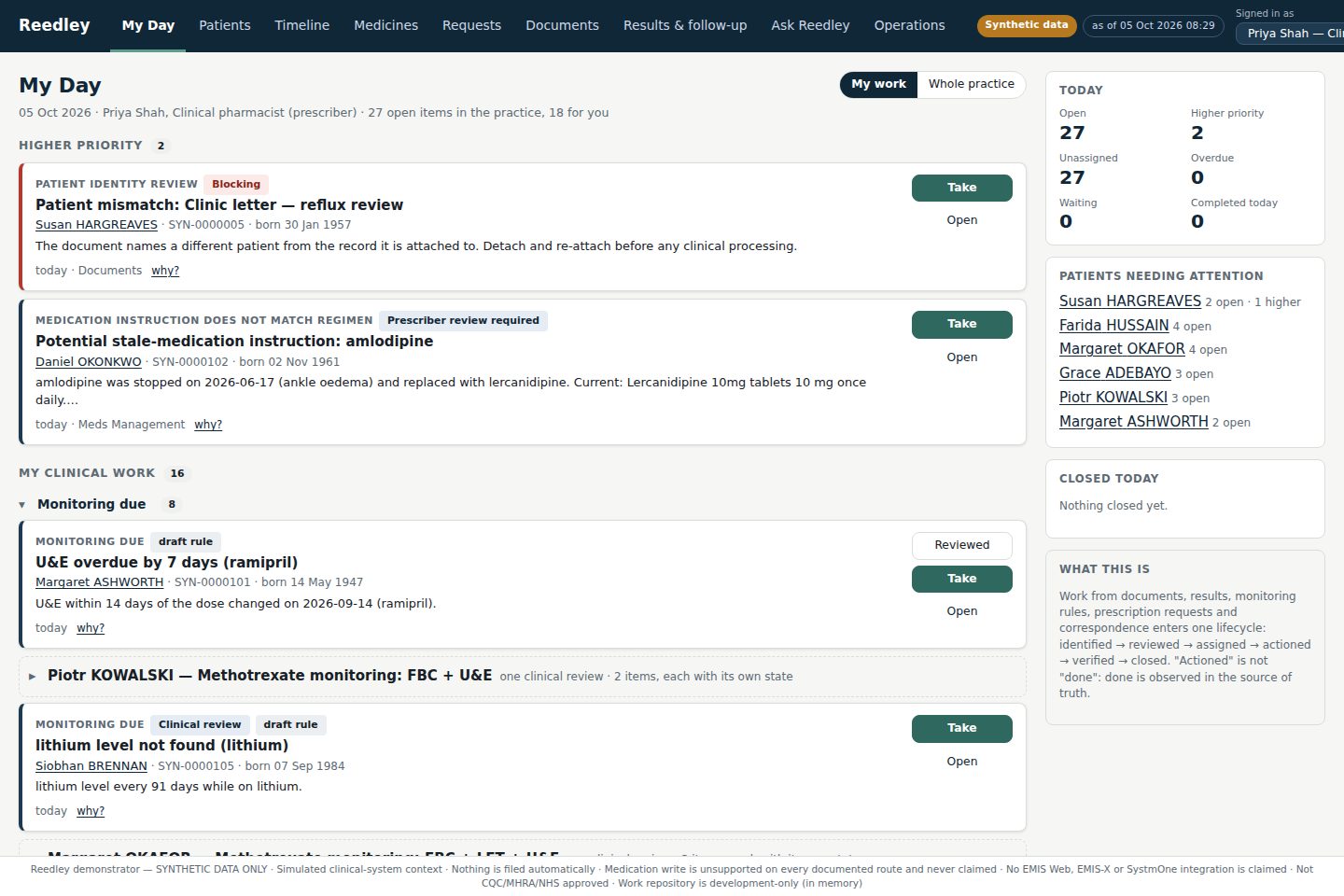
The My Day worklist in the current build. Synthetic data, 5 October 2026. Build block 3: single-pass document review
Document review was rebuilt as a single pass, with identity resolution, related correspondence, coding proposals and review policy floors.
- Identity resolution with five statuses; review is blocked until a person confirms a mismatch.
- Single-pass review: findings with citations, record comparison, proposals, related correspondence and a summary in one view.
- Versioned policy packs and review floors per kind of work that practice settings cannot lower (draft floors, enforced by Reedley’s own screens, not yet by a server).
- Sensitivity review that flags content for a capable person to decide, without changing any visibility flag.
- A durable, append-only work store in development storage (not for real data), passing the same tests as the in-memory version.
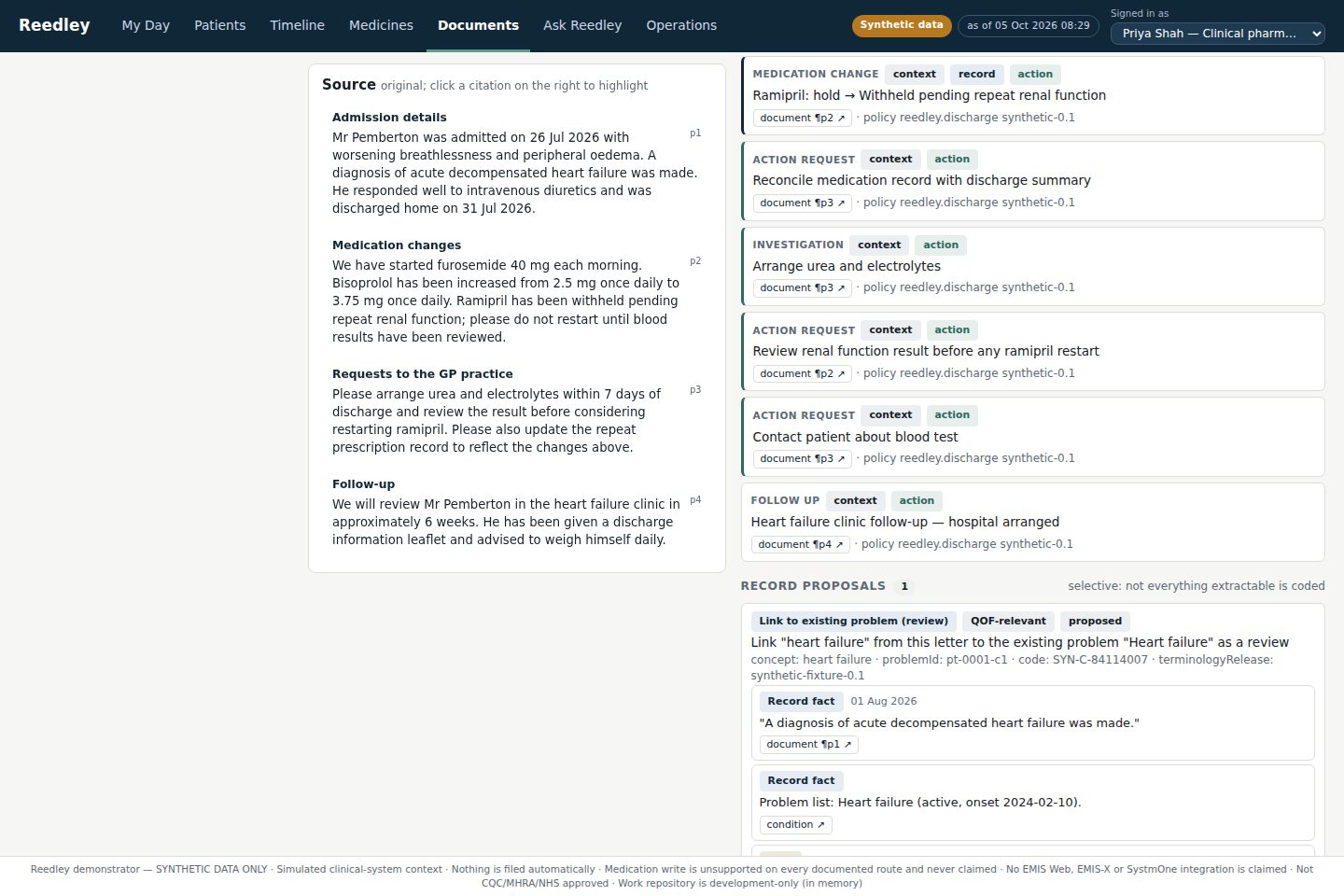
Single-pass document review in the current build. Synthetic data, 5 October 2026. Build block 2: one product, one lifecycle
The earlier document demonstrator became part of a unified product shell around one shared work engine and one lifecycle.
- My Day, patient context with “what changed”, medicines views, documents and operations in one product.
- The canonical lifecycle — identified, reviewed, assigned, actioned, verified, closed — with an append-only history.
- An evaluation harness that separates false negatives from false positives, and a draft DCB0129 hazard log.
Reedley brand identity
The Reedley identity was established, including the rule that the brand’s Reed Green may signal workflow progress but never clinical severity or patient outcome.
- Wordmark, mark and palette designed for clinical calm.
- A product vocabulary that separates what the record states from what the system infers.