Reedley is in development. Everything shown on this site uses synthetic data.
Evaluation pack · for forwarding
A supplier introduction you can forward.
Ten short sections for practice partners, PCN leads and NHS digital staff, written so it can be circulated internally without a conversation first. The PDF and the printable version are generated from the same content as this page and carry the same date. Every product image uses synthetic data.
No practice uses Reedley yet · Tested on synthetic data only · No EMIS Web or SystmOne integration claimed
Dated 14 November 2026 · the PDF is checked against this content before release · no customers, outcomes, approvals or certifications are claimed.
01 Proposition
Reedley is a clinical workstation being built for GP practice teams: one place where letters, results, medicines, monitoring and questions about a patient become work that is owned, evidenced and finished — with a named person making every clinical decision.
Documents are how Reedley enters a practice. The workspace around the patient is what the practice keeps using.
In development · tested on synthetic data only · no practice uses it yet · no integration with EMIS Web or SystmOne claimed
No GP practice uses it. No real patient data has been processed. No integration with EMIS Web, EMIS-X or SystmOne exists or is claimed. No Clinical Safety Officer has been appointed, so none has reviewed the draft hazard log, and no medical-device assessment has been made.
Supplier
Reedley Clinical Systems Ltd (in formation — not yet incorporated)
My DayThe work that is yours, with whyCore platform · intended launch scope. Part of the product Reedley intends to launch; see each capability’s status for what exists. Not launch-ready; no clinician has used it.
Patient ContextWhat you need before you open the recordCore platform · intended launch scope. Part of the product Reedley intends to launch; see each capability’s status for what exists. Not launch-ready; no clinician has used it.
DocumentsLetters and results, read with youCore platform · intended launch scope. Part of the product Reedley intends to launch; see each capability’s status for what exists. Not launch-ready; no clinician has used it.
MedicinesReconciliation, status, conflicts and requestsCore platform · intended launch scope. Part of the product Reedley intends to launch; see each capability’s status for what exists. Not launch-ready; no clinician has used it.
Results & MonitoringRead once received, linked to why; designed to stay open until reviewed (the build closes on receipt)Core platform · intended launch scope. Part of the product Reedley intends to launch; see each capability’s status for what exists. Not launch-ready; no clinician has used it.
Ask ReedleyAnswers from the record, and says when it cannotCore platform · intended launch scope. Part of the product Reedley intends to launch; see each capability’s status for what exists. Not launch-ready; no clinician has used it.
Clinical Action EngineOne lifecycle, one owner, verification from evidenceCore platform · intended launch scope. Part of the product Reedley intends to launch; see each capability’s status for what exists. Not launch-ready; no clinician has used it.
OperationsIs work being finished?Core platform · intended launch scope. Part of the product Reedley intends to launch; see each capability’s status for what exists. Not launch-ready; no clinician has used it.
None of the 30 tracked capabilities has passed every launch-readiness gate (5 October 2026).
How it is designed to work
Identify work from documents, results, rules and requests
Explain it with the cited source and the record beside it
Act a named person accepts, edits or rejects each proposal
Verify designed to check the source of truth, not a ticked box
Complete or record why it could not be done
02 Intended users
Clinical pharmacistscorrespondence with medication changes, reconciliation, request preparation, monitoring
GP partners and clinical leadsoversight, governance and evidence that work is finished
Practice managersone worklist, owners, due dates and visibility
Primary care networksconsistent workflows across practices, with the practice as the data boundary
03 Illustrative interfaces
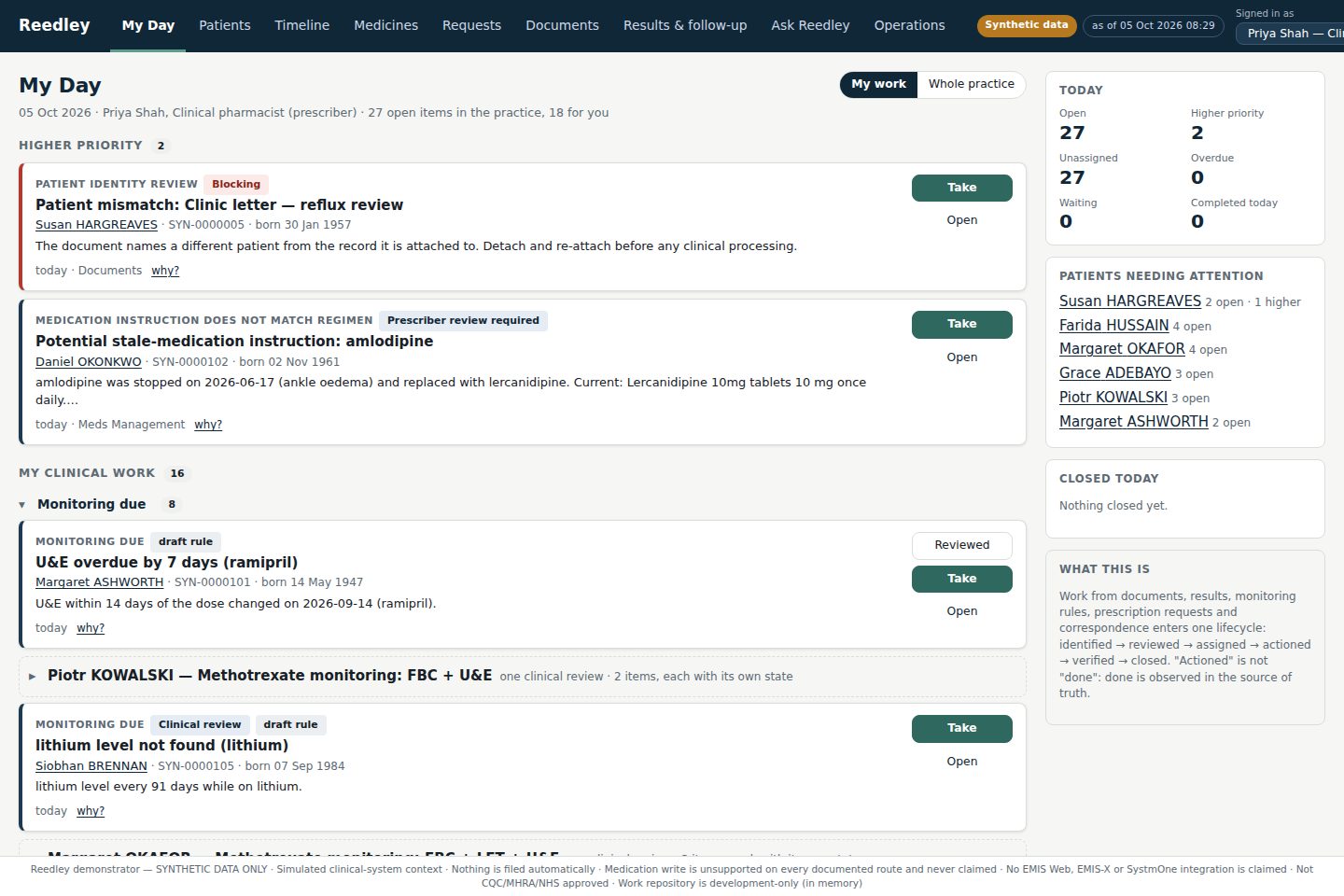
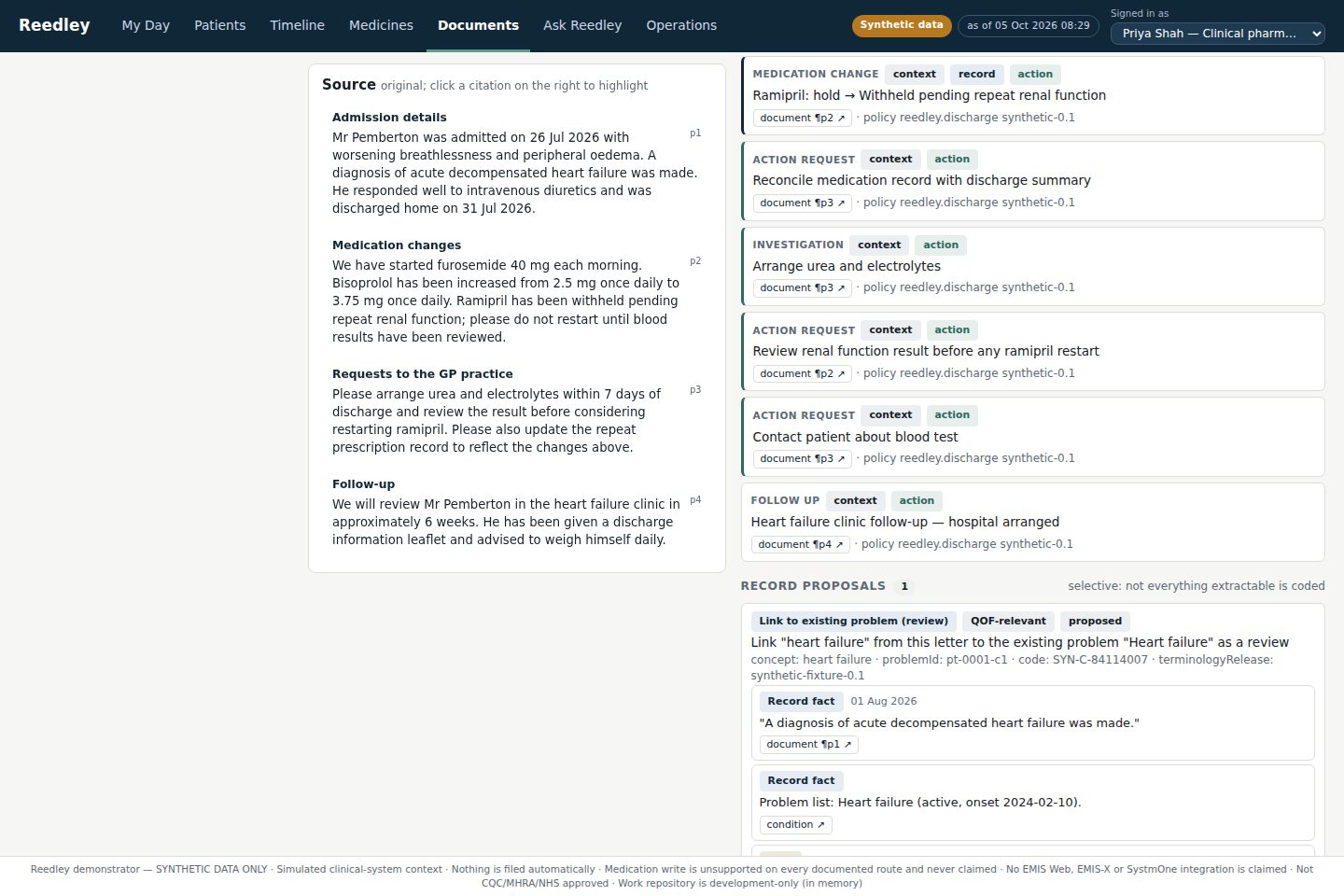
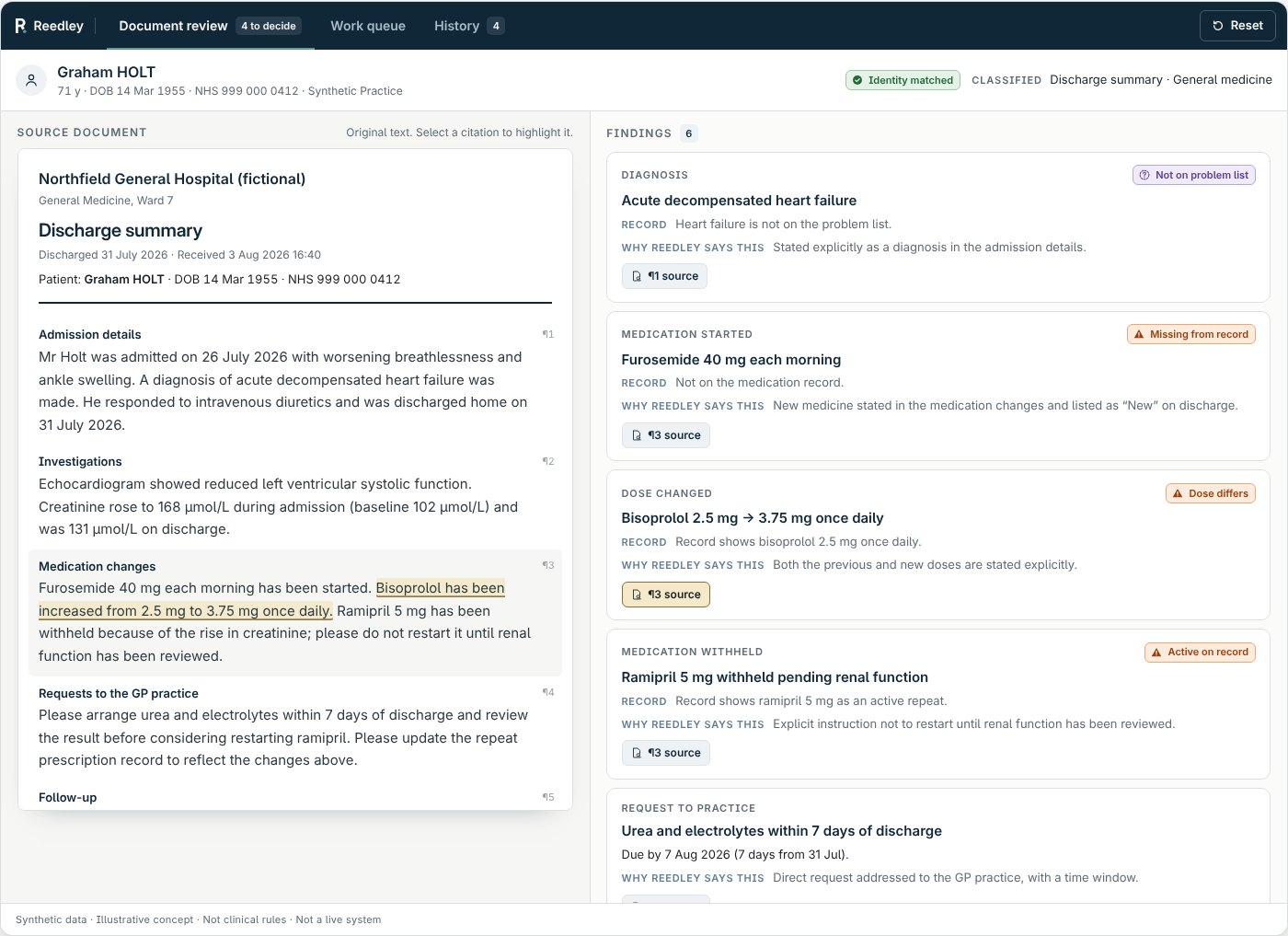
Three views from the current build and the interactive demonstration. Every patient, document and result in them is synthetic.
The My Day worklist in the current build. Synthetic data, 5 October 2026.Single-pass document review in the current build. Synthetic data, 5 October 2026.Document review in the interactive demonstration. Synthetic data; not a live system; not clinical rules.
04 Workflow examples
The three synthetic scenarios in the interactive demonstration, each with what it is designed to show. The outputs are pre-written and deterministic; no AI model runs in the demonstration.
Discharge summaryHospital discharge summary
Three medication changes, two requests to the practice and a hospital-arranged follow-up, after an admission with heart failure.
Every finding links to the exact passage it came from.
The medication record is compared, not changed.
Each proposal needs a named person to accept, edit or reject it.
A booked blood test is not a result, and a received result is not a reviewed one: the item is designed to stay open until the review is recorded (the development build closes it on receipt).
A received blood panel for a patient on methotrexate. It evidences an open monitoring item and carries a laboratory flag for clinician review.
A received result can prove that open monitoring work happened.
A received result is not a reviewed result: monitoring is designed to close only after the flagged value has a recorded clinician review (the development build closes it on receipt).
Laboratory flags are shown as reported; Reedley does not interpret results.
Review rules are designed to be named, versioned and owned by a named clinician. Today they are unsigned drafts with no named owner; this one is marked draft.
Read correspondence and results with the reviewer, citing the exact passage for every finding
Compare what a document says with what the record shows, and say where they differ
Propose work, coding and record updates for a named person to accept, edit or reject
Route work to the right person with a due date and the reason it exists
Look for evidence that work actually happened before treating it as complete
Keep an append-only history of who decided what, when, and on what evidence
Reedley does not
Prescribe, or add, stop or change a medicine in the clinical record
Diagnose, or interpret what a result means for a patient
File, code or send anything without a person’s decision
Treat conditional wording such as “consider” as an instruction
Verify work on a tick. A person’s report moves an item to actioned; verification comes from the record where Reedley can read it; where it cannot, a named person’s structured statement is accepted today, and that rule is under review.
Replace the clinical system, which remains the record
06 Current maturity
Every capability with its status as at 14 November 2026. The tier says what Reedley intends for each module; the status says what exists. Built · synthetic data means domain logic with automated tests in the current build, on synthetic data only; its screens are not tested, and part of it is on a branch not yet merged. No capability is launch-ready and no clinician has used the build.
The platform pages use three public states for the same facts: “Built · synthetic data” and “Needs clinical sign-off” are in the development build (synthetic data; draft rules unsigned), “In development” is partly built, and every other status here is not built. An illustrative demonstration can show parts that are not built.
None of the 30 tracked capabilities has passed every launch-readiness gate (5 October 2026).
My Day Core platform · intended launch scope. Part of the product Reedley intends to launch; see each capability’s status for what exists. Not launch-ready; no clinician has used it.Built · synthetic data
Capability
What it does
Status today
Role-aware worklist
A clinical pharmacist, a GP and a medical secretary each see their own queue from one engine, with higher-priority work first and clinical detail withheld where the role has no scope for it.Before real use: In-memory in the browser; no clinician has used it.
Built · synthetic data
Grouping without losing state
Related work is shown together — one clinical review, several items — while each item keeps its own lifecycle state.
Built · synthetic data
“Why?” on every item
The rule or source and the derived evidence behind an item, with every source openable.
Built · synthetic data
Six-state lifecycle with evidence
Identified, reviewed, assigned, actioned, verified, closed. A person’s report moves an item to actioned; verification comes from the record where Reedley can read it; where it cannot, a named person’s structured statement is accepted today, and that rule is under review.
Built · synthetic data
Review policy floors
Each kind of work has a minimum review level that practice settings cannot lower, enforced by Reedley’s screens only: the development build has no authenticated user, and one re-test recorded a person closing an unreviewed item.Before real use: Floors need Clinical Safety Officer sign-off; enforcement outside the screens is not built.
Needs clinical sign-off
Role-based access within the practice
Each role sees what it needs; every access attempt is recorded. On the branch awaiting review (since 14 November), a GP, pharmacist or nurse sees safeguarding-classified content with a flag and an audited view by default; non-clinical roles need an explicit grant, and a practice can withhold it from clinicians only by recording a rationale. Not reviewed by a Clinical Safety Officer, safeguarding lead or information-governance lead.Before real use: Enforced by Reedley’s screens only; the development build has no authenticated user. Information governance review of the model is outstanding.
Built · synthetic data
Patient Context Core platform · intended launch scope. Part of the product Reedley intends to launch; see each capability’s status for what exists. Not launch-ready; no clinician has used it.Built · synthetic data
Capability
What it does
Status today
Purpose-led overview
General, medication review, acute or diabetes review: the same record, prioritised for the question in hand, with every line openable to its source.Before real use: Prioritisation weights are hand-set; no real-record evaluation.
Built · synthetic data
What Changed
Changes grouped by date and source since your last review when Reedley has one, otherwise since an explicit window.Before real use: “Last review” is derived from Reedley’s own events and simulated encounters only.
Built · synthetic data
Meaningful timeline
Record, derived-episode and work events on one timeline, each labelled with its origin, filtered by category.Before real use: Derived episodes are lexical hints, labelled Reedley-derived and not clinically reviewed.
Built · synthetic data
Freshness and coverage
Snapshot time, source and “N of M events shown” on every view; Reedley’s screens refuse action on an out-of-date view until it is recalculated.
Built · synthetic data
Documents Core platform · intended launch scope. Part of the product Reedley intends to launch; see each capability’s status for what exists. Not launch-ready; no clinician has used it.Built · synthetic data
Capability
What it does
Status today
Identity check before anything else
Matches the document to the patient on weighted evidence and blocks review until a person confirms a mismatch.Before real use: No national or clinical-system identity route; synthetic candidates only.
Built · synthetic data
Single-pass document review
Classification, findings with citations, what is new, related correspondence and a summary, in one view.Before real use: Extraction accuracy is not established: one model run, on synthetic development documents only.
Built · synthetic data
Source-linked findings
Every statement links to the passage it came from, quoted verbatim.
Built · synthetic data
Related correspondence
Shows related letters and what is new in each; a long-term condition alone does not make one episode.Before real use: Lexical rules only; precision unmeasured.
Built · synthetic data
Proposals, not actions
Coding and record-update proposals that a named person accepts, rejects with a reason, or edits.Before real use: Synthetic prototype: synthetic terminology only; no route to write coded entries.
Synthetic prototype. An end-to-end workflow that runs on synthetic data with a synthetic intake or unsigned rules. Shown to illustrate the design; not part of the launch scope until signed off.Built · synthetic data
Sensitivity and visibility review
Flags sensitive content for a capable person to decide; never changes a visibility flag itself.
Built · synthetic data
Integrity checks and processing restrictions
Integrity checks at intake; a document under a processing restriction is returned by hand with nothing extracted.
Built · synthetic data
Live document intake
Receiving documents from the practice’s real inbound routes.Before real use: Needs an approved route (for example MESH redirect or a supplier interface).
Needs supplier approval
Medicines Core platform · intended launch scope. Part of the product Reedley intends to launch; see each capability’s status for what exists. Not launch-ready; no clinician has used it.In development
Capability
What it does
Status today
Instruction comparison
A classifier in the development build’s domain code compares each instruction in a letter with the current regimen, on synthetic data. It has no screen of its own.Before real use: No screen of its own; dm+d and real-letter evaluation outstanding.
Built · synthetic data
Medication reconciliation workspace
Side-by-side review of a letter against the record, a decision on each line, an action list and a handover. Shown on the capability page as an illustrative demonstration of intended workflow.Before real use: Not built; it depends on a decision about how a clinician’s account of an action is recorded.
Planned
Medication status
Collates the record entries about an inactive medicine under a status label such as temporarily held, intentionally stopped, acute issues lapsed or reason not established, quoting the entries behind it. The prescriber decides.Before real use: The medication timeline is populated from a synthetic adapter; stops without a recorded reason stay invisible.
Built · synthetic data
Restart context
Shows what happened before a medicine stopped and what has happened since, for a prescriber to decide.
Built · synthetic data
Instruction conflicts shown for review
Collates, for a prescriber’s review, an instruction in a letter that does not match what has happened since, with the possible explanations listed without choosing one and a clarification request drafted for a clinician to send or discard.Before real use: Synthetic prototype: synthetic letters and records only. Whether this description falls within medical-device regulation has not been assessed.
Synthetic prototype. An end-to-end workflow that runs on synthetic data with a synthetic intake or unsigned rules. Shown to illustrate the design; not part of the launch scope until signed off.Built · synthetic data
Prescription request triage
A synthetic prototype that sorts the morning’s requests for a prescriber’s review by the type of finding each carries — specialist instruction conflict, inactive medicine requested, dose discrepancy, ambiguous status, monitoring constraint, recent specialist change — or none found by the listed checks. Every request still goes to a prescriber.Before real use: Synthetic prototype: the intake is synthetic and the sorting rules are unsigned drafts; no route to the practice’s real request queue. Whether these descriptions fall within medical-device regulation has not been assessed.
Synthetic prototype. An end-to-end workflow that runs on synthetic data with a synthetic intake or unsigned rules. Shown to illustrate the design; not part of the launch scope until signed off.Needs clinical sign-off
Prescription brief
Each request with the current state, the previous stop, later entries, recent changes, the latest relevant result, monitoring and specialist instructions, and the checks performed. It never labels a request “safe”.Before real use: Synthetic prototype awaiting clinical sign-off.
Synthetic prototype. An end-to-end workflow that runs on synthetic data with a synthetic intake or unsigned rules. Shown to illustrate the design; not part of the launch scope until signed off.Needs clinical sign-off
Writing to the medication record
Adding, stopping or changing medicines in the clinical system.Before real use: Deliberately not built. Any future write would need supplier approval, Clinical Safety Officer sign-off and a medical-device determination.
Withheld by design · not built
Results & Monitoring Core platform · intended launch scope. Part of the product Reedley intends to launch; see each capability’s status for what exists. Not launch-ready; no clinician has used it.Needs clinical sign-off
Capability
What it does
Status today
Results read from the record
A result is read once it has been received in the record (Reedley is not an inbound pathology receiver), shown as the laboratory reported it, with the laboratory flag as the only urgency.
Built · synthetic data
Results in context
Shows a result with why it was requested, which monitoring requirements it satisfies and which open work it verifies. Reedley does not interpret results.
Built · synthetic data
Monitoring due and overdue
Work items for medicines that need blood tests, from a versioned rule table.Before real use: Draft rule table with no clinical owner; to be signed off before use.
Needs clinical sign-off
Follow-up loops
Monitoring, referral, recall and specialist follow-up loops projected from work and the record, with any stalled or skipped step stated.Before real use: Synthetic prototype: booking and communication verification are not simulated; a loop closes only on the outcome observed in the record.
Synthetic prototype. An end-to-end workflow that runs on synthetic data with a synthetic intake or unsigned rules. Shown to illustrate the design; not part of the launch scope until signed off.Needs clinical sign-off
Freshness of derived information
Every derived output carries the record snapshot it came from and is marked out of date when the record changes; Reedley’s screens block action on it until it is recalculated.
Built · synthetic data
Recall creation and invitations
Creating recalls and inviting patients through the practice’s own tools.
Planned
Automatic verification from live systems
Confirming work happened from the clinical record, e-RS, pathology or booking systems.
Needs supplier approval
Ask Reedley Core platform · intended launch scope. Part of the product Reedley intends to launch; see each capability’s status for what exists. Not launch-ready; no clinician has used it.Built · synthetic data
Capability
What it does
Status today
Cited answers
Every line of an answer carries the record fact and the document paragraph it came from; duplicate letters inside one episode count once.Before real use: Accuracy not measured: no real-record testing exists.
Built · synthetic data
Answerability gate
“Reedley cannot answer this reliably from the records currently available” when coverage is insufficient; absence of evidence is never shown as proof of absence.
Built · synthetic data
Advice boundary
A question that asks what to do is answered with the patient-specific evidence and a plain statement that Reedley does not give treatment advice.
Built · synthetic data
Coverage in words
What was searched, how many records, which sources are unavailable, and from which date — never a percentage.
Built · synthetic data
Historical answers
An answer produced before the record changed is marked historical and superseded; asking again produces a current one.
Built · synthetic data
Model-assisted planner
In the current build no language model is consulted; a model-assisted planner, if added, would return the same auditable plan.Before real use: Any model use needs its own evaluation and governance before it is switched on.
Planned
Clinical Action Engine Core platform · intended launch scope. Part of the product Reedley intends to launch; see each capability’s status for what exists. Not launch-ready; no clinician has used it.Built · synthetic data
Capability
What it does
Status today
Frozen lifecycle
Identified → reviewed → assigned → actioned → verified → closed, the same six words in the database, the interface and the audit trail.
Built · synthetic data
Verification from evidence
A person’s report moves an item to actioned; verification comes from the record where Reedley can read it; where it cannot, a named person’s structured statement is accepted today, and that rule is under review.Before real use: Source checks are simulated until approved access exists.
Built · synthetic data
Review policy packs
Versioned packs with authority levels and floors per work kind; the “why?” on every item comes from them.Before real use: No pack has a named owner; floors need CSO sign-off.
Needs clinical sign-off
Work repository
An append-only history of every decision with its evidence, in the development server store; the browser build keeps history in memory only, and it is lost on reload.Before real use: Development storage only; a production store is planned and not built.
Built · synthetic data
Operations Core platform · intended launch scope. Part of the product Reedley intends to launch; see each capability’s status for what exists. Not launch-ready; no clinician has used it.In development
Capability
What it does
Status today
Operations view
Run log, lifecycle metrics, quality signals, freshness summary and the platform-status table with honest labels.Before real use: Reporting beyond one screen is not built.
In development
Versioned practice configuration
Teams, routing, capabilities and policy packs with author, time, previous and new values; a change that would lower a Reedley floor is recorded as refused, with the reason.Before real use: Synthetic prototype: the editor is a test harness; no onboarding flow.
Synthetic prototype. An end-to-end workflow that runs on synthetic data with a synthetic intake or unsigned rules. Shown to illustrate the design; not part of the launch scope until signed off.Built · synthetic data
Completion and not-required rates
Completion rate counts verified outcomes; the not-required rate is reported separately as a precision signal.Before real use: Synthetic prototype: simulated rows on synthetic data only.
Synthetic prototype. An end-to-end workflow that runs on synthetic data with a synthetic intake or unsigned rules. Shown to illustrate the design; not part of the launch scope until signed off.Built · synthetic data
Time-released evidence
A defensible method for measuring time released in real practices.Before real use: Needs pilot data. No time-saving figure is claimed.
Planned
QOF and contract intelligence
Indicator trajectories and the work that would close gaps.
Planned
07 Integration limitations
Reedley is designed for UK primary care, including workflows around EMIS Web and SystmOne. No integration with either exists or is claimed today.
Designed forWhere Reedley isReedley is designed around workflows in EMIS Web and SystmOne practices, using a simulated clinical system in development.
Enquiry madeNext stepFormal enquiries to the relevant supplier and national programmes. Not yet made.
Access granted for testingLaterFor example, initiation of IM1 pairing with access to a mock or test environment.
AssuredLaterAssurance completed for a defined scope, such as IM1 “Recommended to Connect”.
Live with a practiceLaterRunning for a practice under a governed pilot, for the assured scope only.
Until the ladder moves, nothing is written to any clinical record, and “source checks” in the demonstration are simulated to show how verification is meant to work once approved access exists.
08 Current assurance status
The public assurance register as at 14 November 2026. No dates are committed; each row says what exists today.
Standard
Status
Today
DCB0129 — clinical risk management in the manufacture of health ITClinical safety
In progress
An engineering draft of the hazard log and a safety-case outline exist alongside the build. Severities are provisional. No Clinical Safety Officer has been appointed, so none has reviewed them, and they are not a safety case.
DCB0160 — clinical risk management in the deployment and use of health ITClinical safety
Not applicable
DCB0160 is completed by the organisation deploying a system, such as a GP practice. It is not Reedley’s standard to complete, but Reedley will provide the information a practice needs for its own assessment.
Medical device qualification (MHRA, UK MDR 2002)Regulation
Not yet assessed
Reedley has not determined whether any part of the product is a medical device. The founder has recorded a working hypothesis per feature; features that shape prescribing decisions may fall within scope. No specialist has reviewed that hypothesis.
DTAC — Digital Technology Assessment Criteria (version 2.0)Procurement
Planned
Not started. DTAC covers clinical safety, data protection, technical security, interoperability, and usability and accessibility, so it depends on the items above.
DSPT — Data Security and Protection ToolkitInformation governance
Planned
Not started. Reedley does not currently process any NHS patient data.
ICO registration and supplier DPIA (UK GDPR)Data protection
Planned
No patient data is processed today. The website collects business contact details only, as described in the privacy notice. Registration with the Information Commissioner’s Office (the data protection fee) is not yet in place, and no form is switched on until it is: by the founder as data controller until the company is incorporated, then by the company.
Cyber Essentials and Cyber Essentials PlusSecurity
Planned
Not yet certified.
Independent penetration testSecurity
Planned
Not commissioned. During development the website has had automated security checks run by the build and code reviews by AI review agents. No person has carried out a security test and none of it is independent, so it does not replace an independent test.
Clinical-system integration (for example IM1 pairing)Integration
Not yet assessed
No integration with EMIS Web, EMIS-X or SystmOne exists or is claimed. The build runs against a simulated clinical system. Integration routes have been researched; no application has been made.
WCAG 2.2 level AA (this website)Accessibility
In progress
This website has WCAG 2.2 AA as its target and was checked during development with automated tests run by the build, including scripted keyboard checks, and by AI review agents. No person has audited it, and it has not had an independent audit.
Real-world evaluation with practicesClinical evaluation
Planned
No clinician has used Reedley yet. A walkthrough pack for synthetic-data sessions and a pilot protocol are drafted. One model-in-the-loop run on synthetic development documents exists; the locked holdout has not been sent to a model.
09 Prospective pilot structure
Four stages, at your pace. Each stage is optional, and nothing moves to real data without the approvals described.
01
A conversation
An hour to understand your workflows, systems and pressures, and whether a pilot makes sense for you. No commitment.
02
Synthetic walkthroughs
Your team uses Reedley on synthetic patients and documents modelled on your real workflows, built without using any of your patients’ records. No patient data is involved.
03
Structured feedback
Timed tasks and short interviews with pharmacists, GPs and administrative staff, reported honestly — including what did not work. Founder and independent results are reported separately.
04
Governed evaluation
Only if both sides agree, and only once everything in the “Before any real patient data” list is in place. None of it is in place today.
Before any real patient data
None of the following is in place today. All of them must be, for the scope concerned, before Reedley processes any real patient data, including in a pilot:
A clinical safety case report for the pilot scope, approved by a Clinical Safety Officer (DCB0129), and the practice’s own DCB0160 assessment
A written opinion from a regulatory specialist on whether any feature is a medical device (MHRA), and any registration or conformity assessment that requires
Reedley Clinical Systems Ltd incorporated and registered with the Information Commissioner’s Office
A Data Security and Protection Toolkit submission at “Standards Met”
A data protection impact assessment and a data processing agreement with each practice, covering data minimisation, retention and deletion
Cyber Essentials Plus certification and an independent penetration test of the product
UK hosting for clinical data, and a published list of sub-processors, including any AI model provider
Encryption in transit and at rest, multi-factor authentication, separate environments with no real data outside production, and tested backup and restore
An incident response plan with named roles and notification routes
Professional indemnity, product liability and cyber insurance
The relevant clinical-system supplier or national approvals (for example IM1) for any integration
An agreed protocol with success measures and a way to stop at any time
Who may be suitable
GP practices in England using EMIS Web or SystmOne
Primary care networks with shared clinical pharmacists
Teams with a named clinical lead willing to give structured feedback
Practices interested in correspondence, medicines and monitoring workflows
What to expect
Eligibility and participation are subject to assessment and appropriate approvals
We will not promise dates or capabilities that are not established
No live clinical data is used without the approvals, safeguards and agreements above
You can withdraw at any stage
10 Contact
Supplier
Reedley Clinical Systems Ltd (in formation — not yet incorporated) · founder Salim Miah MPharm · company information